
Clark County Busted Mugshots and the Register
One jail serves Clark County. The Department of Jail Services runs the Clark County Main Jail, and its online register answers one question: who is in custody right now. It is not a historical arrest index, and it is not a gallery of faces. Under RCW 70.48.100, a jail must keep a timely public register listing confinement and discharge information, while records about a confined person stay confidential. That split shapes everything the county puts on display.
What the roster does show is practical. Names appear with booking details, but no photo, thumbnail, or profile image. Someone processed through intake can be released quickly and vanish from the current table just as fast. The old Jail Work Center has not housed anyone since 2020, so it is not a second booking spot. For an adult actually held in the county, the Main Jail roster is the official place to begin. Juvenile matters run through a separate system entirely.
Clark County Booking Record Fields
Two county tables carry the load: the Clark County Jail Roster and the Recent Releases list. Each offers a thin set of fields. CFN stands for the county file number used inside jail records, and it does not automatically match a court case number. The booking date marks the jail event only. Charge descriptions are just as spare, and they can change later, so the court file remains the place to confirm what was actually filed and how a case ended.
| Field | What it means in Clark County |
|---|---|
| CFN and name | A county table identifier and identity field that can help narrow a follow-up request. |
| Book date and location | The recorded booking date and a current housing/location code, not a finding about the case. |
| Charges | Booking-stage charge information on the roster, subject to later court action. |
| Release date or status | A current roster or today’s-release status, not a case outcome. |
| Booking photo and bond | Neither is a public field on the observed roster. Confirm any court or release information through the appropriate custodian. |
| Court case and disposition | Information that belongs with the Clerk, Superior Court, or District Court rather than the roster itself. |
"Booking" simply means intake. It is the step where the jail records a person after an arrest. "Disposition" is different; it is the court's eventual outcome. Keeping the two apart stops a roster result from being read as a judgment. The county's current table works well for status, yet it is just one piece of the record trail.
Clark County Busted Record Requests
When the public register falls short, go to the source. The CCSO Public Disclosure Unit handles many busted-record requests. You can also contact the custodian who created the material. Include a name. Add a rough date and the agency. Supply any CFN, report number, or case number you have too. Ask for whatever is releasable rather than demanding a specific jail file or booking image. The county's Jail Records page says material beyond the roster stays confidential under RCW 70.48.100. So expect a request to be reviewed, redacted, or denied as the law requires.
- Use the CCSO request form or its online disclosure portal to identify the record narrowly.
- Send a city police report request to the agency that made the report, not to Jail Services by default.
- Watch for the agency’s initial response. RCW 42.56.520 sets five business days for that response, which can provide records, a link, an estimate, a clarification request, or a written denial.
- Use the court record to check what happened after booking. A custody listing does not answer that question.
Copies come with a price tag. The CCSO form charges $0.15 per paper page plus postage. A deposit is allowed. Electronic rates appear in county materials as well. Those run $0.10 per scanned page, $0.05 for every four electronic files, and $0.10 per gigabyte, plus certain actual costs. Remember one limit. A fee schedule covers copies only. Paying it does not entitle anyone to a confidential jail photograph.
The Public Disclosure Unit page is the source shown in this official request-interface image.
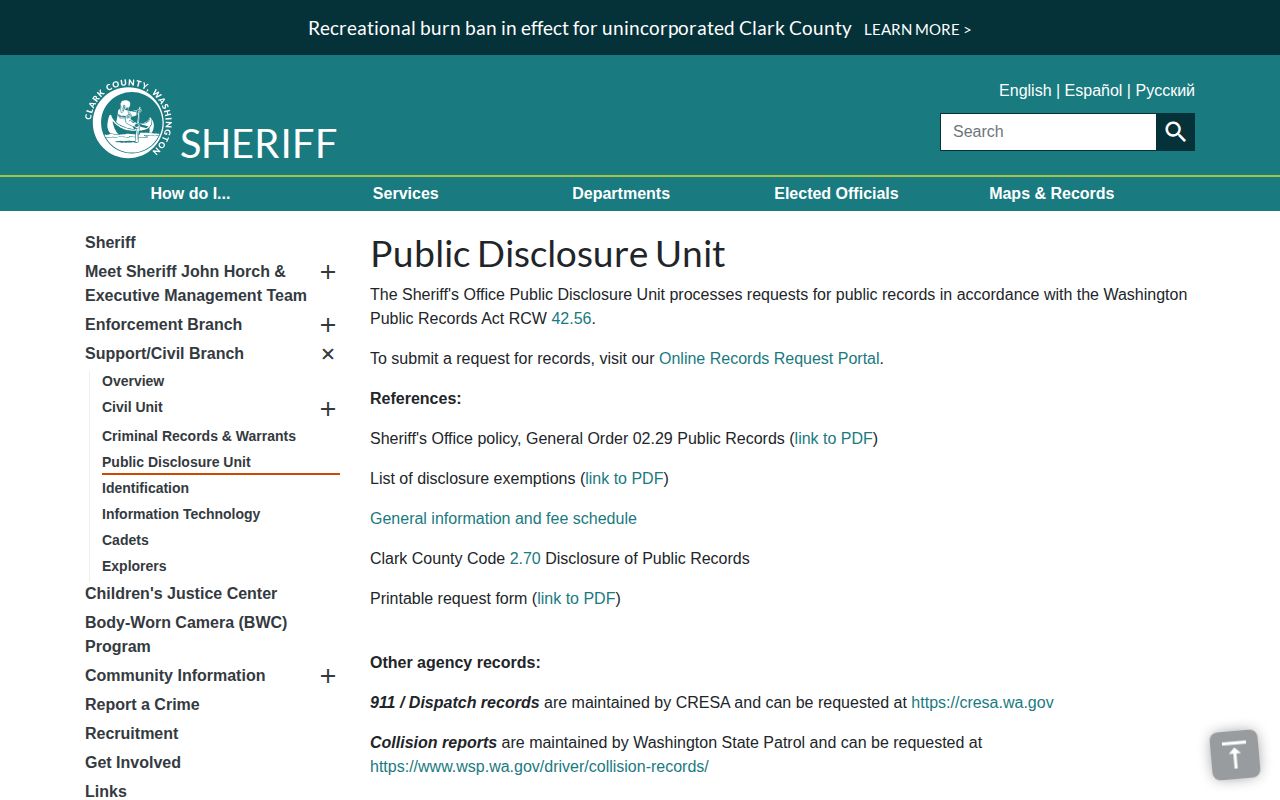
Its links help separate a county request route from any claim that an individual jail record is open to the public.
Washington Mugshot and Jail Record Law
Washington's public-records rule has real edges. RCW 42.56.070 bends to exemptions and other statutes that limit release. RCW 70.48.100 does the heaviest lifting here. It splits the public jail register from confidential confined-person records. No Washington statute grants a general commercial-mugshot removal right. So treat the photo-free roster for what it is. It is not a photo search. No request is guaranteed to produce an image.
Spotted an error in a county record? Use the county's GovQA Public Records Center and cite the CFN or case reference. Court relief works differently. Official Washington Courts forms and statutes cover misdemeanor vacation, felony vacation, and juvenile sealing. Each path has rules that depend on the record and the circumstances. A court or a qualified legal advocate can walk through an individual path. Any correction request should stick to facts. Send it straight to the agency holding the record.
Two secondary publishers have confirmed no-fee correction processes of their own. RecentlyBooked's policy covers documentation for errors, dismissals, sealed or expunged material, and duplicates. Mugshots.com's maintenance page invites free update or removal requests. Neither process is a government finding. Neither fixes the originating record. A commercial listing is never a substitute for a live custody record. The official Washington Courts forms page appears in this court-resource image.
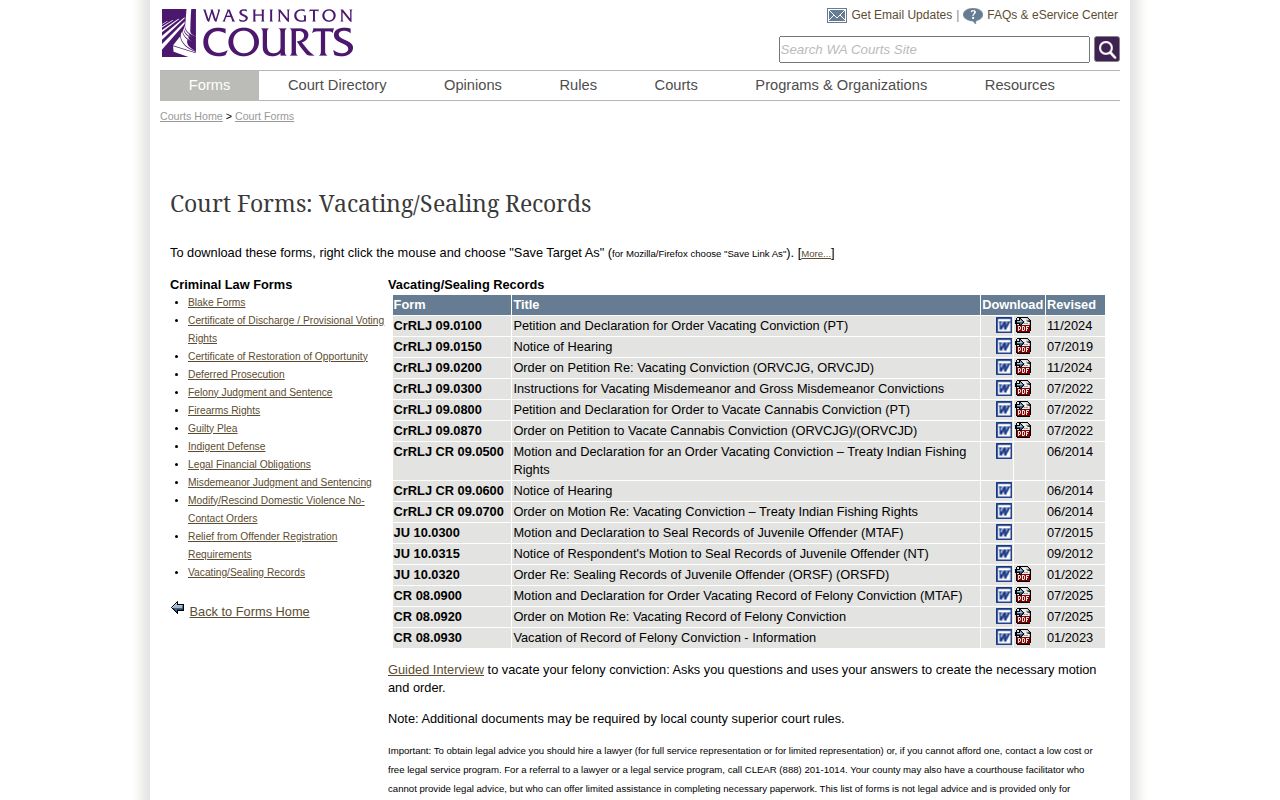
It points toward official court materials rather than a paid removal service or a photo gallery.
Find Clark County Busted Mugshots Officially
Start with custody status. That single fact determines the route. Someone incarcerated in the county jail? Check the jail roster first. A release may have happened today? Move to the Recent Releases table. From there, find the arresting agency for a report, and lean on the Clerk or the right court to follow the case. Each channel answers a different question and confirms where the information came from, which makes this sequence far more useful than a broad web search.
- Open the official Jail Roster and use the book-date range when a date is known.
- Review the current-custody fields and record a CFN or book date only as a lead for the next source.
- Check Recent Releases for a same-day release status.
- Use the police department that made the arrest for its report, then the Clark County Clerk for the court-case path.
- If the person is no longer in county custody, use the state, federal, or records-request route that matches the actual system.
Official sources deserve the first look. The verified Clark County pages come first for a reason. Sites like RecentlyBooked and Mugshots.com are unofficial. They can be incomplete, stale, or archive-like. RecentlyBooked itself states that Clark County does not supply it with mugshot images. Mugshots.com's visible arrest-year choices stop at 2018. For a current answer, rely on the roster, the agency record, and the court case instead.
| Channel | Custody or record scope | Photo result | How to use it |
|---|---|---|---|
| Jail Roster | Current Clark County Jail custody | No public photo field | Use the book-date range and current table. |
| Recent Releases | Today’s release list | No public photo field | Review CFN, name, dates, and status. |
| Agency records | The report-creating agency | Subject to review | Make a focused public-records request. |
| Court records | Filed case and disposition | Not a booking-photo source | Use the Clerk and correct court. |
| Verified secondary pages | Unofficial publisher records | Not authoritative | Treat as a lead only and confirm officially. |
Clark County Jail Roster for Busted Bookings
Think of the Clark County Jail roster as a snapshot of who is in custody right now. It comes with a Book Date filter. Set a start and end date before searching. Each row shows a CFN, the person's name, book date, location, release date, and charges. Click into a record for more detail. You may find the RCW involved, the court, a citation or warrant number, bail type and amount, and release type. All of it reflects the booking stage only. For current bail or an upcoming hearing, check with Jail Services or the court directly.
| Published search field | Use | Limit |
|---|---|---|
| Start book date | Sets the earliest booking date for the current table. | It does not create a historical booking archive. |
| End book date | Sets the latest date for a focused review. | It does not prove a missing person was never booked. |
| CFN and name | Help identify a result after the table returns it. | No observed public general name-search control is advertised. |
| Charge detail | Shows booking/process fields for a result. | It has no public photo field and is not a disposition. |
A blank search is not always bad news. The date range might simply be off. Maybe the person was cited instead of booked, or released already. Juveniles do not appear here, the arrest may have happened at another facility, or a release has already pulled the entry off the current-custody list. Clark County posts no fixed update schedule and no stated window for how long entries stay visible. Treat the table as a current-custody view that shifts with operations, not something refreshed on the hour. The official Jail Roster is where this table lives.
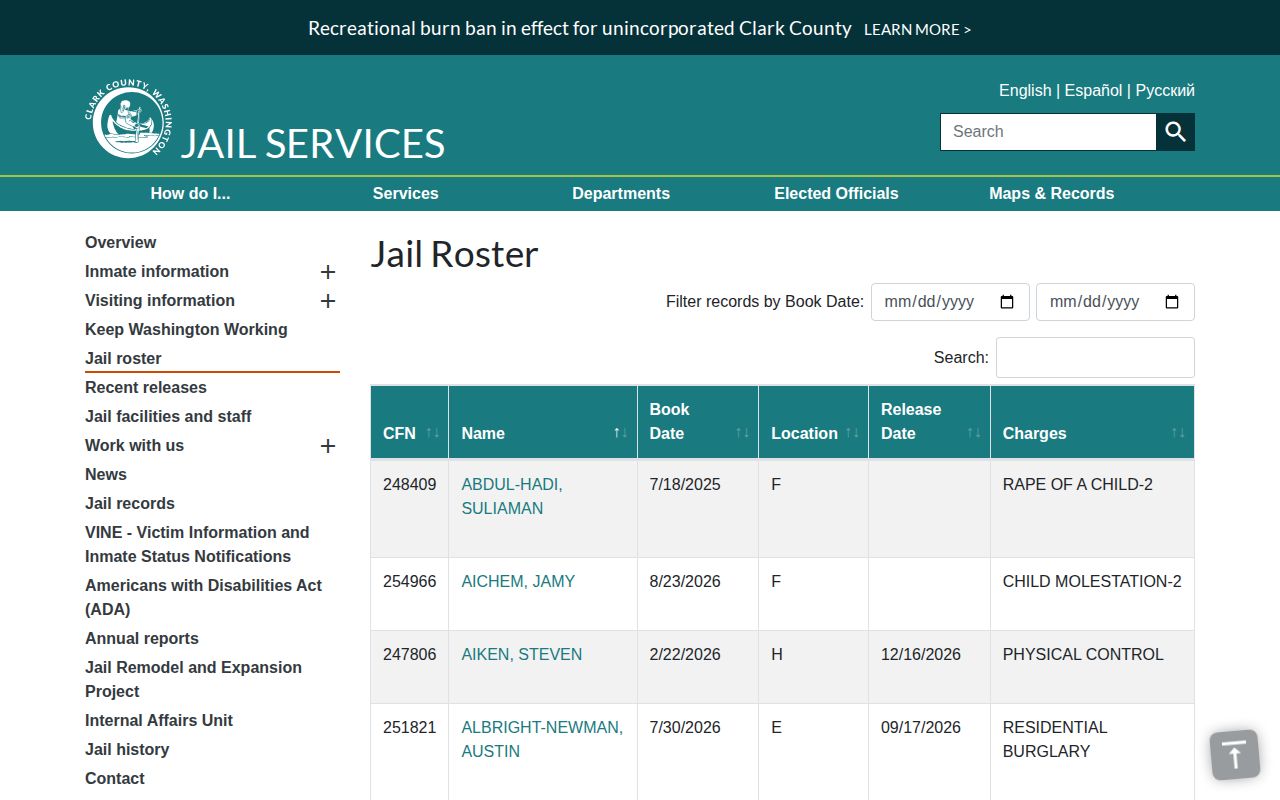
The interface illustrates the date-filtered table and the absence of a public booking-photo column.
Clark County Recent Releases Are Not a Feed
Clark County has no official same-day bookings feed. No 72-hour list, no weekly log, no multi-day booking archive. The roster filters by date, yes. But it only shows who is locked up at a given moment. So once people are released, a date-range search cannot bring back everyone booked in that window. That gap matters most when a jail stay lasted just hours or a day. The nearest official companion is Recent Releases. Its own empty-state wording confirms a today-only window. Its columns cover CFN, name, book date, release date, and status. There are no charges and no booking photos. Read it as a same-day release list, nothing more. When both tables come up empty, turn to the arresting agency's records process or the court file rather than a third-party list.
Note: A release table and a current roster can give different answers because they capture opposite custody states at different moments.
Recent Releases is the official table behind this image.
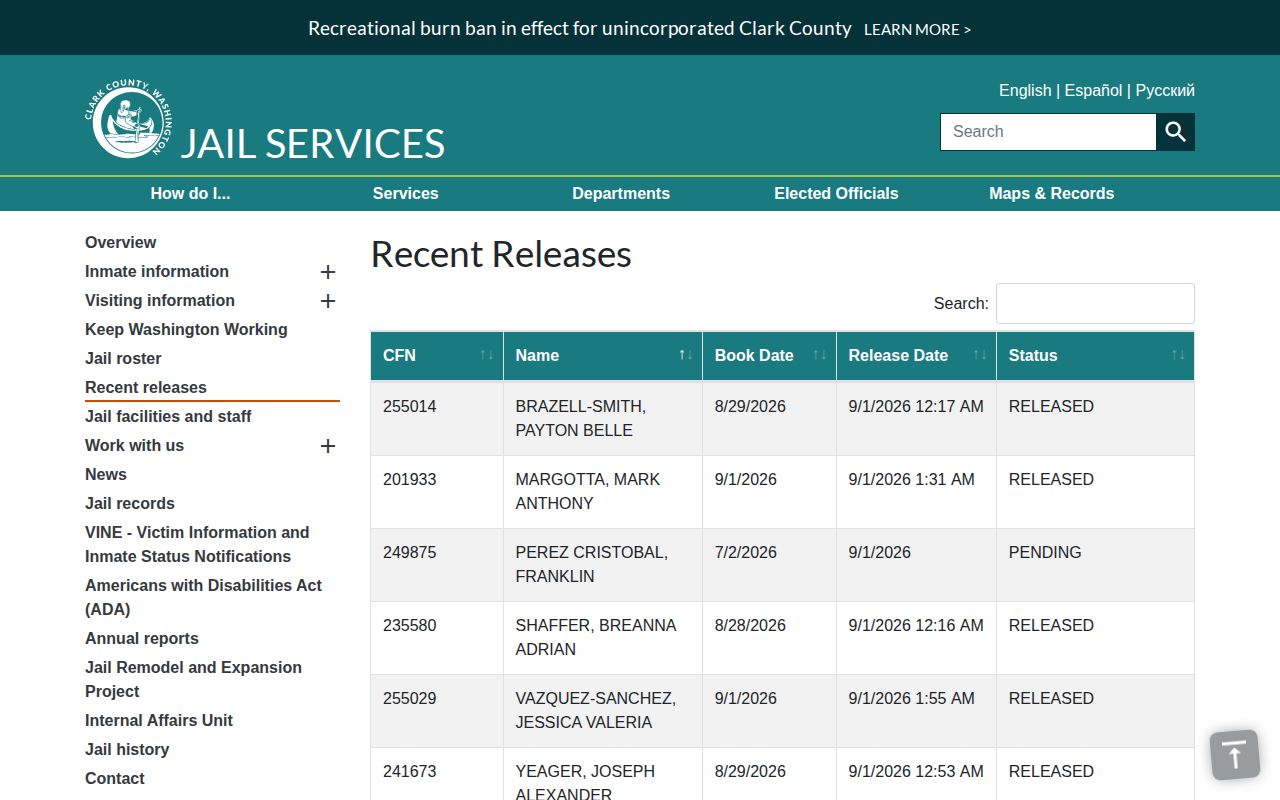
It documents a same-day release view, not a multi-day arrest or booking-photo archive.
Clark County Busted Custody Alerts
For custody alerts, the county's validated tool is Washington VINE. It is not a Sheriff app. It is not a booking-photo service either. Registration is free, and notifications arrive by text, app, email, phone, or TTY. There is also round-the-clock phone access at 1-877-846-3492 and through VINElink. City and county jails plus WA DOC all feed into it through agency interfaces.
VINE answers one question well: did custody status change? It is not an arrest archive. It is not a photo source or a court record. Clark County also cautions that VINE sends no advance notice of a release and should never be the only piece of a safety plan. To learn how a charge ends, follow the matching court case.
No official Clark County Sheriff or Jail Services app exists for inmate lookup or booking photographs. Social channels may post public-safety updates, but silence about a case proves nothing. Stick with the roster, the records custodian, VINE for alerts, and the court for outcomes.
State and Federal Custody Record Searches
Once someone leaves county custody, a Clark roster search will not help. Switch systems instead. The WA DOC Incarcerated Search covers people held in state prisons. It takes a first name, last name, or DOC number. Results show details like name, DOC number, age, location, and notification options. There is no public profile photo, though. And a DOC number is not the same thing as a Clark County CFN.
Federal custody works differently. The Bureau of Prisons Inmate Locator handles federal cases, while the ICE Online Detainee Locator is a separate channel for immigration detention when that applies. Neither one stands in for the county roster or doubles as a historical mugshot search. To request a DOC record, use the agency's public-records request route, which promises an initial response within five business days, subject to exemptions and fees.
The BOP Inmate Locator is the official source shown in this image.
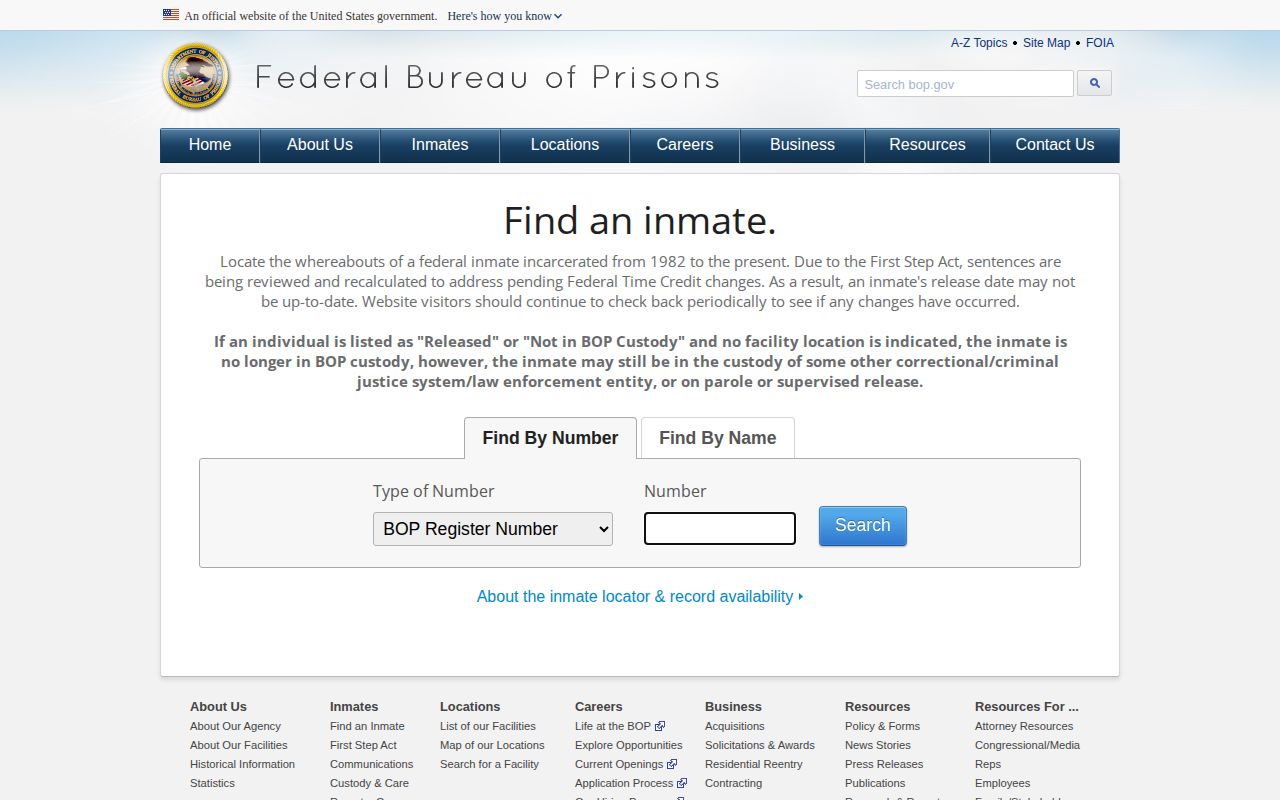
Federal results come from a separate custody system, so they cannot confirm a booking at the Clark County Jail.
Clark County Court Outcomes After Booking
The court file is where a jail booking meets its legal outcome. The Clark County Clerk connects to the statewide Odyssey Portal and a Superior Court name search. Superior Court takes the felony cases as the county's court of general jurisdiction. Misdemeanors and infractions belong to Clark County District Court, the limited-jurisdiction trial court. A CFN can help you make sense of a jail entry. Just do not assume it doubles as a court case number.
Arraignment is the hearing where the court lays out the charges and rights and takes a plea. The District Court daily docket is refreshed by 8:15 a.m. each day with hearing details, though a docket entry is not a final outcome. Check the case file itself for filed status, hearings, and results. One limit worth knowing: District Court recordings are kept for five years from the hearing date under its records guidance. That clock applies to court recordings, not to any jail photograph.
- Booking
- Jail intake after an arrest, which can occur even if a person is released soon afterward.
- Arraignment
- An early court hearing about charges, rights, and a plea.
- Disposition
- The court’s resolution of a case, which may differ from a booking charge.
- Detainer
- A request or hold that can affect custody, not proof of a conviction.
Clark County Busted Mugshots by City
Don't confuse city police news with the county's custody list. The Vancouver Police Department posts selected media releases, kept for 30 days through FlashAlert. Camas Police News leans toward notices and annual-report content, not a rundown of who got booked. Battle Ground Police Department puts out monthly activity reports. Those are numbers, though, and the department itself cautions that one event can generate several arrests, citations, or reports at once. Each city channel adds local color. None of them works as a person-level arrest roster.
- Vancouver Busted Mugshots explains VPD releases, records requests, and adult county-custody routing.
- Camas Busted Mugshots explains CPD’s records path and its absence of a public person-level arrest log.
- Battle Ground Busted Mugshots explains BGPD’s monthly activity series and the county-jail follow-up.
When an adult is actually booked into county custody, the Clark County roster and Recent Releases table are the right stops. Plenty of events never make it there. A city incident notice, a citation, a juvenile case, or a release handled without county housing can all stay off the register. That narrow boundary beats any claim that every city arrest turns into a county record.
Clark County Jail Register Archives
Being online and being kept forever are two different things. Clark County states no retention period for a roster entry or a Recent Releases row. Washington's law-enforcement retention schedule treats Facility Registers as archival, yet that label doesn't make every booking packet or photograph public. Confidentiality rules and sealing orders still apply. Historical custody digging points to the Washington State Archives repositories, the archives catalog, or the Washington Digital Archives.
Older court files take a separate path. The Clerk's Access Records page covers public terminal access to electronic images from 1985 forward, with earlier material sitting on microfilm. That route serves history, not live custody. A current status question goes to Jail Services, an agency report to its creator, and a case outcome to the court.
The adopted retention schedule, version 8.0, marks Facility Registers (the admission, transfer, and release summaries tied to RCW 70.48.100) as archival once agency business ends. It guarantees a permanent register series, not that any individual file, packet, or image was transferred or opened to the public. The confidentiality statute still shapes the answer. An active public-record request or a legal hold blocks destruction while it lasts.
Clark County falls under the State Archives Southwest Region. Its Clark County Sheriff Wanted Posters, 1909–1934 collection holds 335 research records, all historical rather than a live wanted list or jail register. Old court matters belong with the Clerk's route, and archival holdings with the catalog and repository staff. Mixing those channels with current-custody tools builds the wrong expectation about what a record shows today.